
Let's be honest about something that doesn't get said enough in the influencer space. The actual content — the part your audience sees, the fifteen-second clip that gets two million views, the carousel that goes semi-viral on a Tuesday — that part is maybe ten percent of the job. The other ninety percent is the unglamorous, soul-crushing operational slog that nobody shows in their "day in my life" vlogs.
Batch shooting. Reformatting. Exporting. Re-exporting because you forgot TikTok and Reels use slightly different safe zones. Pulling stills for thumbnails. Making quote cards. Adjusting captions. Uploading to six platforms with six different specs. Rinse. Repeat. Every single week until you burn out or hire someone you can't quite afford yet.
This is the part of the creator economy that breaks people. Not the creative work. The operational overhead that scales linearly with every platform you try to maintain a presence on. And it's the reason a new category of AI tools — specifically AI agents — is quietly becoming the most relevant tech development for working creators right now.
The Difference Between AI Tools and AI Agents (And Why Creators Should Care)
You've used AI tools by now. Everyone has. You've typed a prompt into an image generator and gotten something usable. You've run a caption through ChatGPT. You've maybe experimented with AI video. Individual tools, individual outputs, individual moments of "oh that's kind of cool."
The problem is that none of those moments connect to each other. You still have to be the project manager. You're the one copying outputs from one tool, pasting them into another, adjusting formats, maintaining consistency, and keeping track of which asset goes where. The AI did a task. You still did the job.
AI agents work differently. Think of the distinction like this: an AI tool is a really talented freelancer who does exactly one thing well. An AI agent is a production assistant who understands the entire project, knows what needs to happen in what order, and handles the chain of tasks without you micromanaging every step.
Pollo Agent is built around exactly this idea. You don't go to it with one isolated request. You go to it with a creative brief — a campaign concept, a content series, a launch plan — and it orchestrates the workflow. Asset generation, format variations, style consistency, platform-specific outputs. The connective tissue that normally eats your afternoon gets handled systematically instead of manually.
For creators who are essentially running a one-person media company, this isn't a nice-to-have. It's the difference between sustainable output and the kind of schedule that leads to a burnout post with a black-and-white selfie and a caption about "taking some time for myself."
What This Actually Looks Like on a Tuesday Afternoon
Abstract tech descriptions are useless if you can't picture yourself using the thing. So let's walk through some real scenarios that working creators will recognize immediately.
The Weekly Content Machine
You film one long-form video per week. From that single shoot, you need to extract:
- A YouTube thumbnail
- Three to five short-form clips for Reels, TikTok, and Shorts
- A quote graphic for the carousel crowd on Instagram
- A teaser image for your newsletter
- A story announcement with your posting schedule
- Maybe a Twitter/X thread graphic if you're still on that platform
Doing this manually means touching four or five different tools, spending two to three hours on post-production admin that has nothing to do with creativity, and inevitably cutting corners on the platforms you care about least. Which means those platforms underperform. Which means you eventually abandon them. Which means your revenue diversification shrinks.
With an agent workflow, you define the template logic once. Feed in the episode-specific elements — key frames, quotes, topic — and the agent generates the full asset package. You spend twenty minutes reviewing and tweaking instead of three hours building from scratch.
The Brand Deal Deliverables
A brand wants three Instagram posts, two TikToks, one YouTube integration, and a set of story frames. Each with slightly different messaging emphasis. Each needing to feel native to the platform while maintaining the brand's visual guidelines.
This is where creators lose money. Not on the creative fee — on the time spent reformatting and adjusting deliverables that eats into what should be your effective hourly rate. An agent that can take the core creative direction and generate platform-specific variations while maintaining brand consistency turns a two-day deliverable grind into a focused afternoon.
The Merch or Product Launch
You're dropping something — a product, a course, a collab. You need a coordinated visual rollout across every platform, teaser content, countdown assets, launch day graphics, and follow-up content. Traditionally this means either hiring a designer for a week or doing it yourself while neglecting your regular content schedule.
An agent approach lets you build the campaign asset suite from a single brief, iterate quickly on variations, and maintain a visual throughline that makes the whole launch feel intentional rather than thrown together.
Where Artlist Fits Into This
Here's something that separates creators who look professional from creators who look like they're trying to look professional: audio and music licensing.
Nothing screams "I don't know what I'm doing" louder than a trending TikTok sound slapped onto a brand collaboration, or dead silence over a product showcase, or — worst of all — a copyright strike that takes down content you were paid to create.
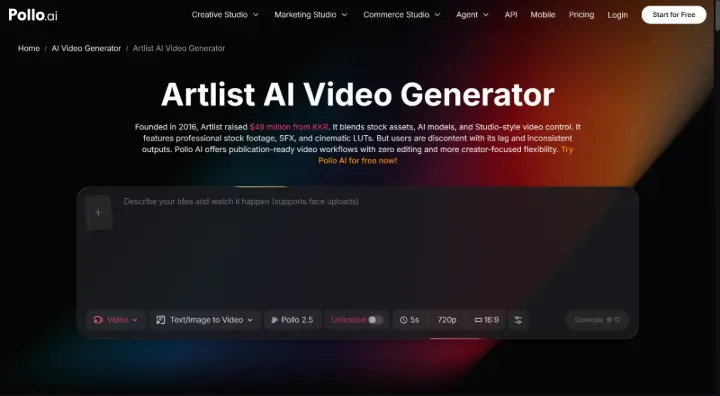
Artlist has carved out a specific and important niche in the creator toolkit. It's a music and sound effects licensing platform built for content creators, with a library designed to actually fit the kind of work creators produce. Not generic stock music that sounds like elevator background noise. Tracks and effects that feel current, that match the energy of short-form content, and that come with licensing terms that won't blow up your channel six months later.
The practical workflow combination here is straightforward and powerful. Pollo Agent handles the visual orchestration — generating and formatting the imagery, video assets, and graphic elements across your content pipeline. Artlist handles the audio layer — providing the music, sound effects, and sonic texture that turns visual content into something people actually feel.
These are complementary problems. Visual production and audio production. One agent handles the complexity of multi-format visual output. The other provides the audio assets that complete the content. Neither is trying to be the other, which is exactly why the combination works.
A creator who has their visual pipeline systematized through an agent and their audio library sorted through a proper licensing platform has eliminated two of the three biggest production bottlenecks. The third — the actual creative idea — is the part that should be taking most of your energy anyway.
The Uncomfortable Truth About Creator Burnout
Let's talk about something the productivity tool space doesn't like to acknowledge. Most creator burnout isn't caused by a lack of tools. It's caused by too many tools, too many manual processes connecting them, and the cognitive overload of being simultaneously the talent, the editor, the designer, the social media manager, the strategist, and the accountant.
Adding another tool to that stack can actually make things worse if it creates one more thing to learn, one more login to remember, one more interface to navigate. This is why the agent model matters beyond just efficiency. It's not another tool in the stack. It's a replacement for the stack management itself.
When an AI agent handles the orchestration layer — the "what needs to happen next and in what format" decisions — it doesn't just save time. It reduces the number of context switches in your day. And context switching is the silent killer of creative energy. Every time you jump from editing software to a design tool to an export settings menu to a scheduling platform, you pay a cognitive tax. It's small each time. It's enormous in aggregate.
Creators who protect their creative energy by systematizing everything that isn't creative work will outlast creators who try to power through on caffeine and discipline alone. That's not a motivational poster sentiment. It's a structural reality of how sustainable careers get built in this space.
What's Actually Worth Your Attention Right Now
If you're a working creator reading this, here's what I'd actually suggest doing rather than just nodding along and closing the tab.
Audit your weekly production time honestly. Track one full content cycle from concept to published across all platforms. Note every tool switch, every manual reformatting step, every moment where you're doing mechanical work instead of creative work. Most creators are genuinely shocked by the ratio when they see it written down.
Identify your most repetitive multi-step process. Not the hardest thing you do. The most repetitive. The thing that follows roughly the same pattern every week but still requires enough attention that you can't fully zone out while doing it. That's your first candidate for agent automation.
Test Pollo Agent on that specific process. Don't try to overhaul your entire workflow at once. Take that one recurring pain point and see how much of it the agent can handle. Judge the output honestly. Where does it meet your standard? Where does it need your eye? Build from there.
Sort your audio situation if you haven't already. If you're still using trending sounds for everything or pulling from sketchy free music sites, you're building on a foundation that can crack at any time. Get a proper Artlist subscription and remove that risk entirely. Your future self — the one who doesn't have to deal with a copyright claim on a video that's driving sales — will thank you.
Protect the creative core ruthlessly. Every hour you reclaim from production mechanics is an hour you can spend on the part of this job that actually builds your career: developing your voice, understanding your audience, creating work that means something to the people who watch it. No AI agent can do that for you. But an AI agent can make sure you actually have time to do it.
Where This Is All Heading
The creator economy is entering a phase where the operational barrier between "person with ideas and a phone" and "functioning media operation" is collapsing. That's good news for talented creators who were held back by production complexity. It's challenging news for creators whose primary advantage was simply having the patience to grind through that complexity.
When everyone can produce at volume, the differentiator becomes what you produce, not how much. Taste, perspective, authenticity, audience understanding — these become the scarce resources. The mechanical production layer becomes commoditized.
Creators who recognize this shift and restructure their workflows accordingly — using agents for orchestration, proper platforms for specialized needs like audio licensing, and reserving their own energy for the irreplaceably human parts of the work — will build careers that last.
The ones who keep grinding manually, wearing their sixteen-hour production days as a badge of honor, will keep burning out and wondering why the algorithm isn't rewarding their effort.
The algorithm doesn't care about your effort. It cares about your output. And the smartest way to improve your output isn't to work harder. It's to stop doing work that a machine can do better and faster while you focus on the work that only you can do.
That's not laziness. That's strategy. And in this economy, strategy wins.
The Creator Grind Is Broken — AI Agents Might Be the Fix Nobody Asked For