
Claude Opus 5 API is Anthropic's flagship reasoning model — released July 24, 2026, priced at $5 per million input and $25 per million output tokens — and it is the strongest drop-in upgrade a coding agent can make this year, because its 1,000,000-token context window is the first one that fits a whole repository in a single call. But the upgrade costs more than tokens: an agent that sends every step to the flagship pays for deliberation on every step, in latency and in output, and that hidden bill is what decides whether the model is a win or a tax. The current rate card and telemetry are on Claude Opus 5; this is the plain version of why your agent wants Opus 5, what agentic loops actually charge, and where the model belongs in your pipeline.
If you already run a coding agent, you have been through this decision before. A new flagship ships, the independent benchmarks look inevitable, and the natural instinct is to point every request at it. The mistake is not upgrading — it is upgrading everywhere at once. An agent is not one call. It is a loop of dozens of calls — file reads, symbol searches, test runs, retries, and long reasoning chains — and the economics of that loop, not the price list, decide what the upgrade really costs.
Why a coding agent wants Opus 5
Coding agents are context-hungry in a way almost nothing else is. A serious refactor touches the schema, the callers, the tests, and a dozen files in between, and an agent that cannot hold all of it loses the thread between calls. Opus 5's 1,000,000-token context window — confirmed on the Artificial Analysis model card — is the first one that comfortably holds a whole mid-size repository, and that single property changes the ergonomics of agentic coding.
Three properties matter for coding agents specifically:
- Context: With the full repository in the window, a refactor can be planned against the actual code instead of the parts that fit. No truncation, no summarised files, no drift between what the agent thinks and what the code says.
- Tool use: Coding assistants do not type answers; they call tools — read this file, search this symbol, run these tests — and iterate on the results. Opus 5 is built around exactly that long chain of structured calls, which is the native mode of every serious coding agent.
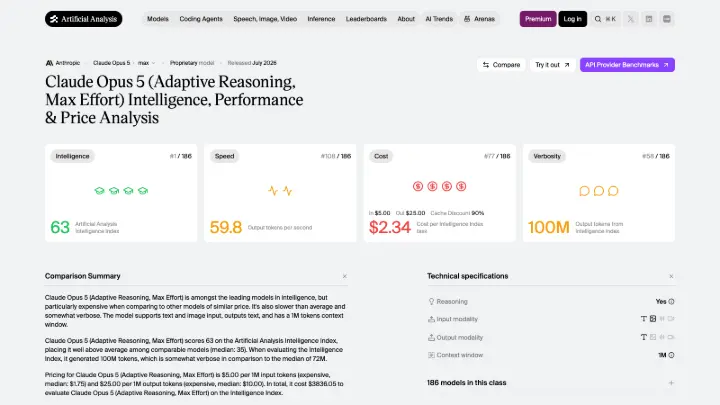
- Long-horizon reasoning: At its maximum effort configuration, Opus 5 posts an Intelligence Index of 63.05, #1 of 185 on the current Artificial Analysis board (independent reading, checked August 22, 2026), and independent positioning calls it near-frontier at half the price of Claude Fable 5. The same index at medium effort drops to 58.64, which is a useful warning: "Opus 5" is really four different models depending on the effort dial, and the coding-agent version wants the high setting.
That is the case for the upgrade, and it is genuine. The interesting part is the price of delivering it inside a loop rather than in a benchmark harness.
The real cost of agentic loops
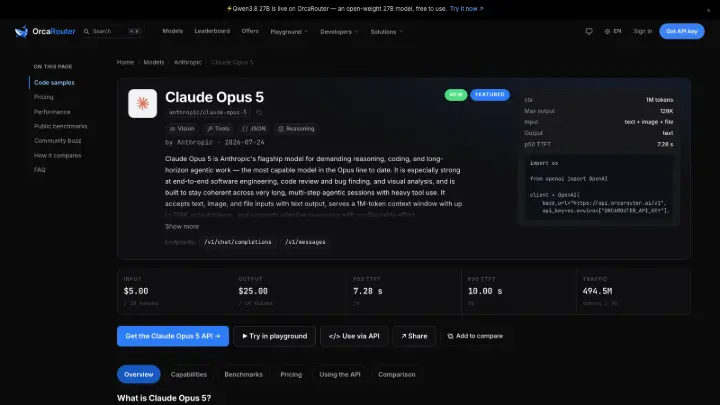
The price list is the honest starting point: $5 per million input tokens, $25 per million output tokens, and $0.50 per million cached input — an 80% reduction on the input side (OrcaRouter price card, verified August 18, 2026). The loop is where it compounds, in two currencies.
Latency per round-trip: Every tool call pays the model's full time-to-first-token before the loop can advance. OrcaRouter's seven-day production telemetry puts Opus 5 at a p50 TTFT of 7.34 seconds and p95 of 10.00 seconds. An agent that makes thirty tool calls in a session is not waiting thirty seconds — it is waiting roughly three and a half minutes before a token streams back. That is acceptable for a deep-refactor agent and brutal for anything interactive.
Output tokens: Agentic sessions are output-heavy: reasoning, function calls, and the final answer are all output tokens, billed at $25 per million. And deliberation has a measured price. Artificial Analysis' independent board shows a single Intelligence Index task with Opus 5 costs $2.34 to evaluate at max effort — versus $1.23 for GPT-5.6 Sol at its max. That $2.34 is not benchmark trivia; it is the measured cost of one hard decision, and a coding agent that deliberates on every micro-step pays it dozens of times per session.
|
Model |
List price ($/1M in · out) |
p50 TTFT (OrcaRouter 7d) |
7-day traffic |
Median output speed (AA) |
|
Claude Opus 5 |
$5 · $25 (cache $0.50) |
7.34 s |
491.5M tokens |
61.8 tok/s |
|
Claude Fable 5 |
$10 · $50 |
4.32 s |
— |
— |
|
GPT-5.6 Luna (after the cut) |
$0.20 · $1.20 |
1.33 s |
21,271.6M tokens |
156.6 tok/s |
Prices are the vendors' current API list prices; TTFT and traffic are OrcaRouter's own seven-day production telemetry; speeds are Artificial Analysis readings. The flagship carries 491.5M tokens in that window while the cheap fast model carries 21,271.6M — the volume workhorse of the network. That gap is the whole argument for not letting the flagship touch every step.
The upgrade over the previous flagship
Anthropic's own positioning is that Opus 5 is the direct replacement for the previous flagship, and the specifics — cost per useful answer, speed deltas, and exactly how the context window grew between generations — are in the coding upgrade analysis linked in the first paragraph. We will not re-litigate those figures here. What matters for agent builders is how the upgrade behaves inside the loop rather than in a harness.
The headline is the 1M window: the previous generation was built around a smaller context, and the whole ergonomics of agentic coding shift when the repository fits. But the previous flagship was already a strong coding model, so the practical difference shows up where the old one broke down — big files, long sessions, multi-file refactors that exhausted the window and forced the agent to re-read or lose state. Opus 5 removes that failure mode, and in return it asks for a bigger budget on exactly the steps where the old model would have succeeded anyway. That is why the upgrade is a routing decision, not a swap.
The practical pattern: spend the flagship where it earns it
The pattern that keeps showing up in teams running Opus 5 in production is a three-tier loop:
1. Orchestrator on a cheap fast model: Planning, file listing, routing, most tool calls — GPT-5.6 Luna-class work at $0.20 in / $1.20 out with a p50 first token of 1.33 seconds (both figures after OpenAI's price cut, per the facts). This is 90% of the calls in a session, and it should not cost flagship money.
2. Opus 5 on the hard step: The refactor that keeps failing, the bug that will not reproduce, the task that needs the whole repository in context. Those steps go to the flagship at max effort, where the 63.05 Intelligence Index and the 1M window earn their keep.
3. Fallback so the agent never hard-fails: If the expensive call errors or times out, drop to a mid-tier model and keep moving. A stalled agent costs more than a slightly weaker answer.
The third tier is why plumbing matters as much as model choice. On OrcaRouter, Opus 5 sits alongside 200-plus models behind one OpenAI-compatible key at 0% markup on list price, with automatic failover — so the agent can spend premium on the hard step and fall back to a cheap fast model without a second integration. The vendor's own API and several third-party platforms also serve the model; the difference is whether cheap/expensive routing is built into the pipe or left to your code.
The takeaway
Opus 5 is the right brain for a coding agent, but it is only the expensive brain. If your loop is short, your repository fits a smaller window, or your budget is metered per call, the deliberation cost — the $2.34 per task Artificial Analysis measures at max effort, multiplied across every round-trip — is a tax, not an upgrade. If your refactors are real, your files are big, and your agent keeps losing the thread mid-task, this is the first flagship whose 1M-token window fixes the actual failure mode. Run the orchestrator on a cheap fast model, send the hard step to Opus 5, and wire the fallback so the loop never hard-fails. On OrcaRouter that means one key, 0% markup, and automatic failover across 200-plus models — which turns the question from "can we afford the flagship" into "where does the flagship belong."
Sourcing note: model identity, the July 24, 2026 release date, and the 1M context window are Anthropic's published claims, confirmed on the Artificial Analysis model card; all benchmark figures (Intelligence Index 63.05, #1 of 185; the 58.64 medium-effort reading; 61.8 tok/s speed; $2.34 and $1.23 cost per task) are from Artificial Analysis' independent live board, checked August 22, 2026; pricing ($5/$25/$0.50, Fable 5 $10/$50, Luna $0.20/$1.20 after the cut) is the vendors' current API list, verified against our price card August 18, 2026; TTFT figures (p50 7.34s, p95 10.00s) and traffic (491.5M vs 21,271.6M tokens/7d) are OrcaRouter's own seven-day production telemetry, checked August 22, 2026. Opus 4.8 year-over-year figures are cited to our comparison blog rather than reproduced here.
Claude Opus 5 for Coding Agents: The 1M-Context Upgrade That Costs More Than Tokens